Learn Medical Animation
Key Summary
Medical animation is one of the most specialised and technically demanding forms of animation out there.
3D animation adds a whole new layer of complexity over 2D. Alignment, depth and lighting all become significantly harder.
Learning keyboard shortcuts early makes a huge difference.
The software professionals use is expensive. There are more accessible options for beginners.
AI is already disrupting this space, and the work that used to take weeks can now be done in a fraction of the time.
Scientific accuracy in medical animation genuinely matters. These visuals shape how people understand and conduct science.
How It Started
This one came about unexpectedly.
A few years after finishing my biomedical science degree, I was approached by a medical animation company about a director of science communications role. The job would have involved fact-checking scripts and working with stakeholders to manage projects. It sounded genuinely interesting, and looking into it was the first time I'd realised medical animation was even a thing.
I didn't take the role, but the idea stayed with me.
It felt like a natural intersection of three things I was already interested in. Creative storytelling, science and learning new technologies. I also liked the idea of understanding what goes into it, both from a craft perspective and as a potential side project in the space.
So I decided to give it a go. Worth mentioning that this was back in 2020, far before AI had made it significantly more accessible, and with zero animation experience to speak of.
The Experience
My vision was simple. A red blood cell moving through a blood vessel. One of the more straightforward constructs in biology, or so I thought.
I started by teaching myself Autodesk Maya, the industry-standard software for 3D animation, used in everything from blockbuster films to award-winning visual effects. It offers a 30-day free trial, which felt like plenty of time to get started.
At the time, there weren't many tutorials available, and even fewer that specialised in medical animation specifically. I did manage to find a YouTube tutorial on building a 3D car, which I thought could be a good one to get the basics down before attempting to figure out the medical animation on my own.
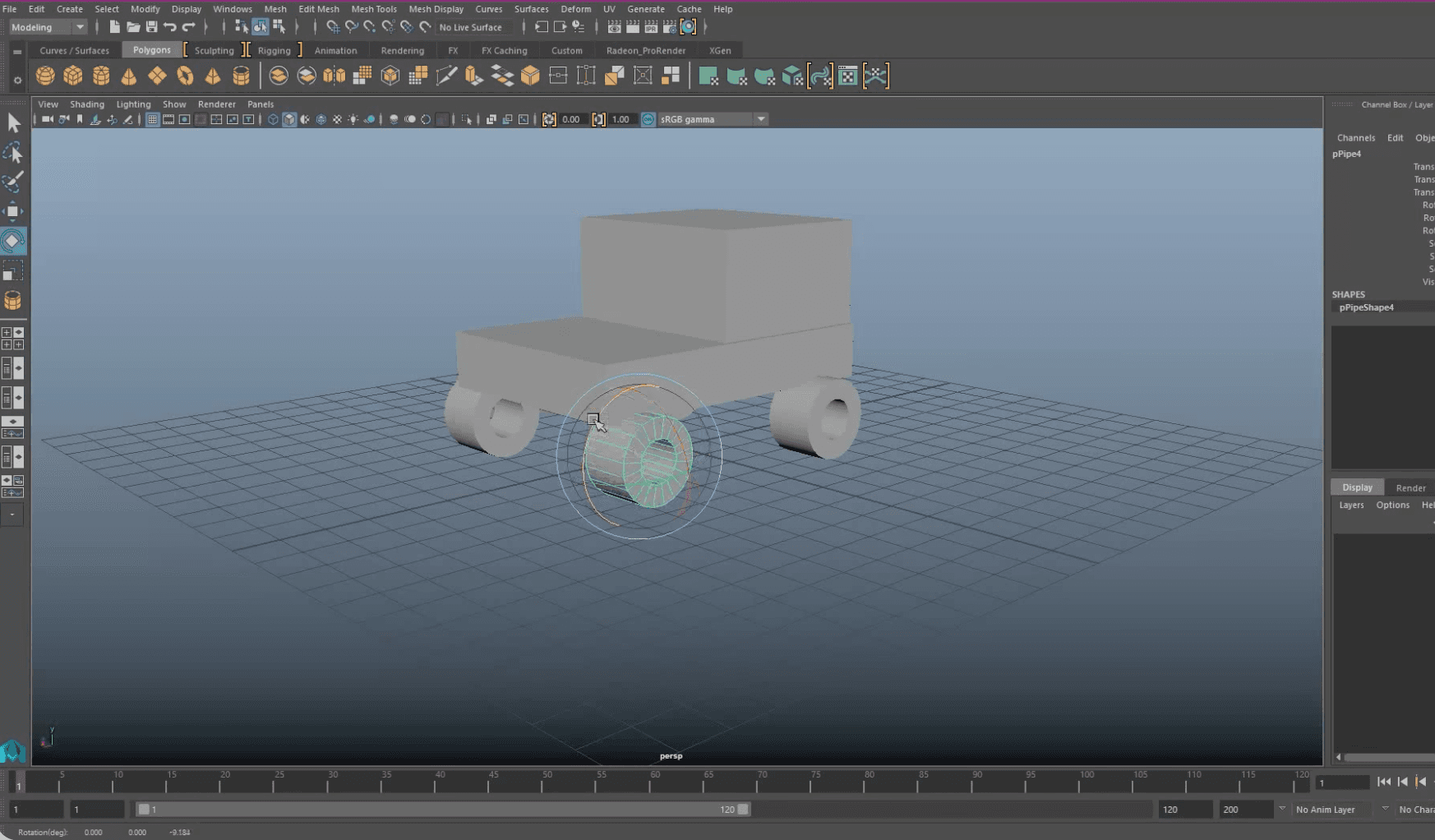
Although the car looks a bit basic, it taught me a huge amount about how 3D space works and the layers of complexity that come with it. 2D animation doesn't prepare you for keeping everything aligned, managing depth and understanding how light interacts with shapes, and that's before any movement is added. These are all things I had to figure out from scratch.
Taking the time to learn keyboard shortcuts early made a real difference. In 3D animation, you're constantly switching between various views and tools, and doing it manually slows everything down considerably.
Then came the blood cell.
What I hadn't appreciated was how technically challenging a red blood cell actually is to recreate. It's not just a circle. It has that distinctive biconcave shape, and getting the depth of the indent right, colouring it to look three-dimensional, and adjusting the light as it moved along the blood vessel took days of trial and error. On top of that, a red blood cell spins as it travels along a vessel, which adds yet another layer of complexity to get right.
Being a bit of a perfectionist, this element was important to me. I wanted to create a pathway for the cell to travel along the vessel and duplicate it into smaller versions to show how multiple cells travel together.
Given how long it had taken me to create and animate one red blood cell, I decided to scale back my original vision. The plan had been to include white blood cells, neutrophils and other cells you'd typically find in a blood vessel, but I made the call to keep it to red blood cells only.

Knowing when to reduce the scope, at times, is just as important as the work itself. Even with this change, the whole project took well over a month. It was honestly one of the most frustrating things I've taken on for Project 50.
To make matters worse, just as I was approaching the end, my free trial expired. I emailed Autodesk to see if they'd consider extending it for my project, even offering them the option to use my article as a case study.
No such luck. They're geared toward professional animators rather than personal projects, which is fair enough. Maya's full subscription is significantly more than I was willing to pay at that stage. I had essentially learned to drive on the Ferrari of animation software.
The result looked good, but unfortunately, I didn't have the video saved locally and hadn't quite got around to adding the background.
What I Took Away
This was, without doubt, the most technically challenging project I took on for Project 50, and I can honestly say it tested my patience and perseverance to the max!
But it taught me things I use to this day. When I create animations or presentations in my work, I have a much greater spatial awareness of how elements sit together and a better understanding of how texture and depth can bring something to life.
It also gave me a much deeper appreciation for keyboard shortcuts. Before this project, I thought they were a bit gimmicky. Now I actively look for them in every piece of software I use, and they save me a considerable amount of time every week.
For geeks among you Briskine is a great tool for customising your own keyboard shortcuts for emails/ text.
What also stayed with me was the broader importance of medical animation as a field. So much of the scientific world is invisible to us, and animation is one of the most powerful tools we have for making it tangible.
The choices animators make, the colours they assign to cells, the shapes they use to represent molecules, the way they show movement, become the mental models that students, researchers and the public carry with them. When those visuals are inconsistent or inaccurate, it can distort how we understand and build on scientific knowledge.
Revisiting this project now, I'm struck by how much has changed. In 2020, creating even a basic medical animation took weeks of painstaking work and industry-level software. Today, AI tools are beginning to make this kind of work significantly more accessible. The craft and scientific knowledge still matter enormously, but the barrier to entry is dropping fast. It's going to be a fascinating space to watch.
This is a short animation (way better than mine) that took me less than 5 minutes to create with Canva AI design:
Would I go back to it? Honestly, probably not now that AI tools have advanced to this level. The technical side was fascinating, but the part I enjoyed most was the creative side, coming up with the animation concept and thinking through how to depict it visually. Storytelling using animation is definitely something I'd like to revisit, but with AI doing more of the heavy lifting, it feels a lot more accessible than it did in 2020.
Special Thanks
To the medical animation company that approached me about that role. I didn't take the job, but the conversation planted a seed that turned into one of the most challenging and rewarding projects of Project 50.
To Autodesk Maya, for being simultaneously the best and most humbling software I've ever used. The free trial was genuinely appreciated, even if it did run out at the worst possible moment.
To the creator of the car tutorial that got me started. Without it, I'm not sure I'd have got anywhere at all.
Learn Medical Animation
Key Summary
Medical animation is one of the most specialised and technically demanding forms of animation out there.
3D animation adds a whole new layer of complexity over 2D. Alignment, depth and lighting all become significantly harder.
Learning keyboard shortcuts early makes a huge difference.
The software professionals use is expensive. There are more accessible options for beginners.
AI is already disrupting this space, and the work that used to take weeks can now be done in a fraction of the time.
Scientific accuracy in medical animation genuinely matters. These visuals shape how people understand and conduct science.
How It Started
This one came about unexpectedly.
A few years after finishing my biomedical science degree, I was approached by a medical animation company about a director of science communications role. The job would have involved fact-checking scripts and working with stakeholders to manage projects. It sounded genuinely interesting, and looking into it was the first time I'd realised medical animation was even a thing.
I didn't take the role, but the idea stayed with me.
It felt like a natural intersection of three things I was already interested in. Creative storytelling, science and learning new technologies. I also liked the idea of understanding what goes into it, both from a craft perspective and as a potential side project in the space.
So I decided to give it a go. Worth mentioning that this was back in 2020, far before AI had made it significantly more accessible, and with zero animation experience to speak of.
The Experience
My vision was simple. A red blood cell moving through a blood vessel. One of the more straightforward constructs in biology, or so I thought.
I started by teaching myself Autodesk Maya, the industry-standard software for 3D animation, used in everything from blockbuster films to award-winning visual effects. It offers a 30-day free trial, which felt like plenty of time to get started.
At the time, there weren't many tutorials available, and even fewer that specialised in medical animation specifically. I did manage to find a YouTube tutorial on building a 3D car, which I thought could be a good one to get the basics down before attempting to figure out the medical animation on my own.
Although the car looks a bit basic, it taught me a huge amount about how 3D space works and the layers of complexity that come with it. 2D animation doesn't prepare you for keeping everything aligned, managing depth and understanding how light interacts with shapes, and that's before any movement is added. These are all things I had to figure out from scratch.
Taking the time to learn keyboard shortcuts early made a real difference. In 3D animation, you're constantly switching between various views and tools, and doing it manually slows everything down considerably.
Then came the blood cell.
What I hadn't appreciated was how technically challenging a red blood cell actually is to recreate. It's not just a circle. It has that distinctive biconcave shape, and getting the depth of the indent right, colouring it to look three-dimensional, and adjusting the light as it moved along the blood vessel took days of trial and error. On top of that, a red blood cell spins as it travels along a vessel, which adds yet another layer of complexity to get right.
Being a bit of a perfectionist, this element was important to me. I wanted to create a pathway for the cell to travel along the vessel and duplicate it into smaller versions to show how multiple cells travel together.
Given how long it had taken me to create and animate one red blood cell, I decided to scale back my original vision. The plan had been to include white blood cells, neutrophils and other cells you'd typically find in a blood vessel, but I made the call to keep it to red blood cells only.
Knowing when to reduce the scope, at times, is just as important as the work itself. Even with this change, the whole project took well over a month. It was honestly one of the most frustrating things I've taken on for Project 50.
To make matters worse, just as I was approaching the end, my free trial expired. I emailed Autodesk to see if they'd consider extending it for my project, even offering them the option to use my article as a case study.
No such luck. They're geared toward professional animators rather than personal projects, which is fair enough. Maya's full subscription is significantly more than I was willing to pay at that stage. I had essentially learned to drive on the Ferrari of animation software.
The result looked good, but unfortunately, I didn't have the video saved locally and hadn't quite got around to adding the background.
What I Took Away
This was, without doubt, the most technically challenging project I took on for Project 50, and I can honestly say it tested my patience and perseverance to the max!
But it taught me things I use to this day. When I create animations or presentations in my work, I have a much greater spatial awareness of how elements sit together and a better understanding of how texture and depth can bring something to life.
It also gave me a much deeper appreciation for keyboard shortcuts. Before this project, I thought they were a bit gimmicky. Now I actively look for them in every piece of software I use, and they save me a considerable amount of time every week.
For geeks among you Briskine is a great tool for customising your own keyboard shortcuts for emails/ text.
What also stayed with me was the broader importance of medical animation as a field. So much of the scientific world is invisible to us, and animation is one of the most powerful tools we have for making it tangible.
The choices animators make, the colours they assign to cells, the shapes they use to represent molecules, the way they show movement, become the mental models that students, researchers and the public carry with them. When those visuals are inconsistent or inaccurate, it can distort how we understand and build on scientific knowledge.
Revisiting this project now, I'm struck by how much has changed. In 2020, creating even a basic medical animation took weeks of painstaking work and industry-level software. Today, AI tools are beginning to make this kind of work significantly more accessible. The craft and scientific knowledge still matter enormously, but the barrier to entry is dropping fast. It's going to be a fascinating space to watch.
This is a short animation (way better than mine) that took me less than 5 minutes to create with Canva AI design:
Would I go back to it? Honestly, probably not now that AI tools have advanced to this level. The technical side was fascinating, but the part I enjoyed most was the creative side, coming up with the animation concept and thinking through how to depict it visually. Storytelling using animation is definitely something I'd like to revisit, but with AI doing more of the heavy lifting, it feels a lot more accessible than it did in 2020.
Special Thanks
To the medical animation company that approached me about that role. I didn't take the job, but the conversation planted a seed that turned into one of the most challenging and rewarding projects of Project 50.
To Autodesk Maya, for being simultaneously the best and most humbling software I've ever used. The free trial was genuinely appreciated, even if it did run out at the worst possible moment.
To the creator of the car tutorial that got me started. Without it, I'm not sure I'd have got anywhere at all.