Life Drawing
Key Summary
You meet all types at a life drawing class, from complete beginners to experts. It's a really open and inclusive environment
You don't need expensive equipment. Charcoal, basic paper, ink and cocktail sticks are as cheap as they come
Life drawing is a surprisingly good way to stay present in the moment
It gives you a better appreciation for shape and the small details you'd normally walk straight past
Don't let perfect be the enemy of good
It's as much about the process as the finished piece
How It Started
This one started with a chance conversation at the gym.
My neighbour and legendary gym buddy Emma mentioned she was heading to a life drawing class that evening and asked if I wanted to join.
I'd never been to one before and, if I'm honest, I wasn't entirely sure how I felt about the idea. Drawing someone naked felt a little strange, especially as I wouldn't class myself as particularly artistic.
But I was excited to go nonetheless.
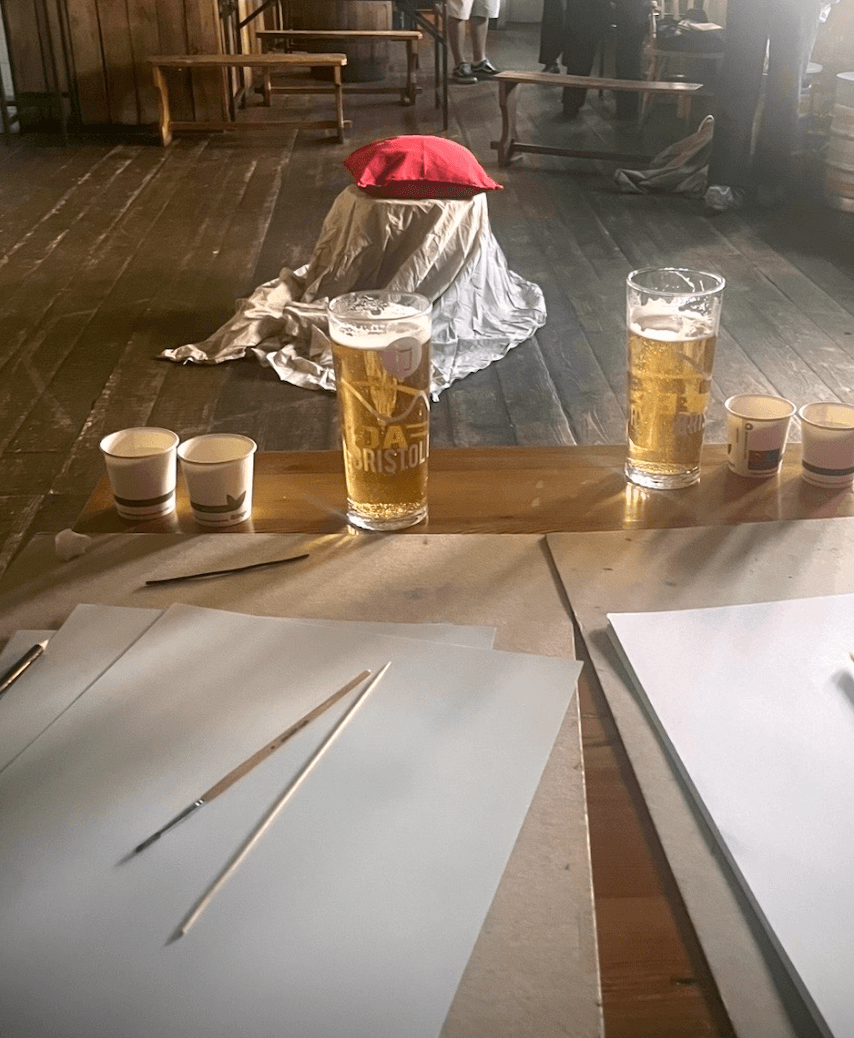
The class was held at the Grain Barge, a local bar on a boat at the bottom of my road, hosted by local illustrator Laurel Molly. At just £9 on the door, it's one of the best value evenings out in Bristol. You can find out more and grab tickets here.
Emma and I decided to go for a few pints beforehand, have a bit of a laugh and see what happened. (I won't lie, the drinks helped!)
What I didn't know at the time was that Emma was a graphic designer and a really good artist!
The Experience
We walked into the room and picked up our paper and a selection of charcoal, ink and cocktail sticks - not quite the utensil I was expecting.
What struck me most was how confident and self-assured the model was, both in herself and her body. And how normal it felt for her to undress in front of us.
The teacher set us challenges throughout the session.
30 seconds to capture the form. A minute. 5 minutes. 10 minutes. 20 minutes.
We were also asked to experiment by drawing just using a continuous line, and also using our non-dominant hand.
It may sound counterintuitive, but the restrictions were actually freeing. You had no time to second-guess or start over, so you were forced to just draw and accept what came out on the paper.
We worked with 2 different media throughout the evening:
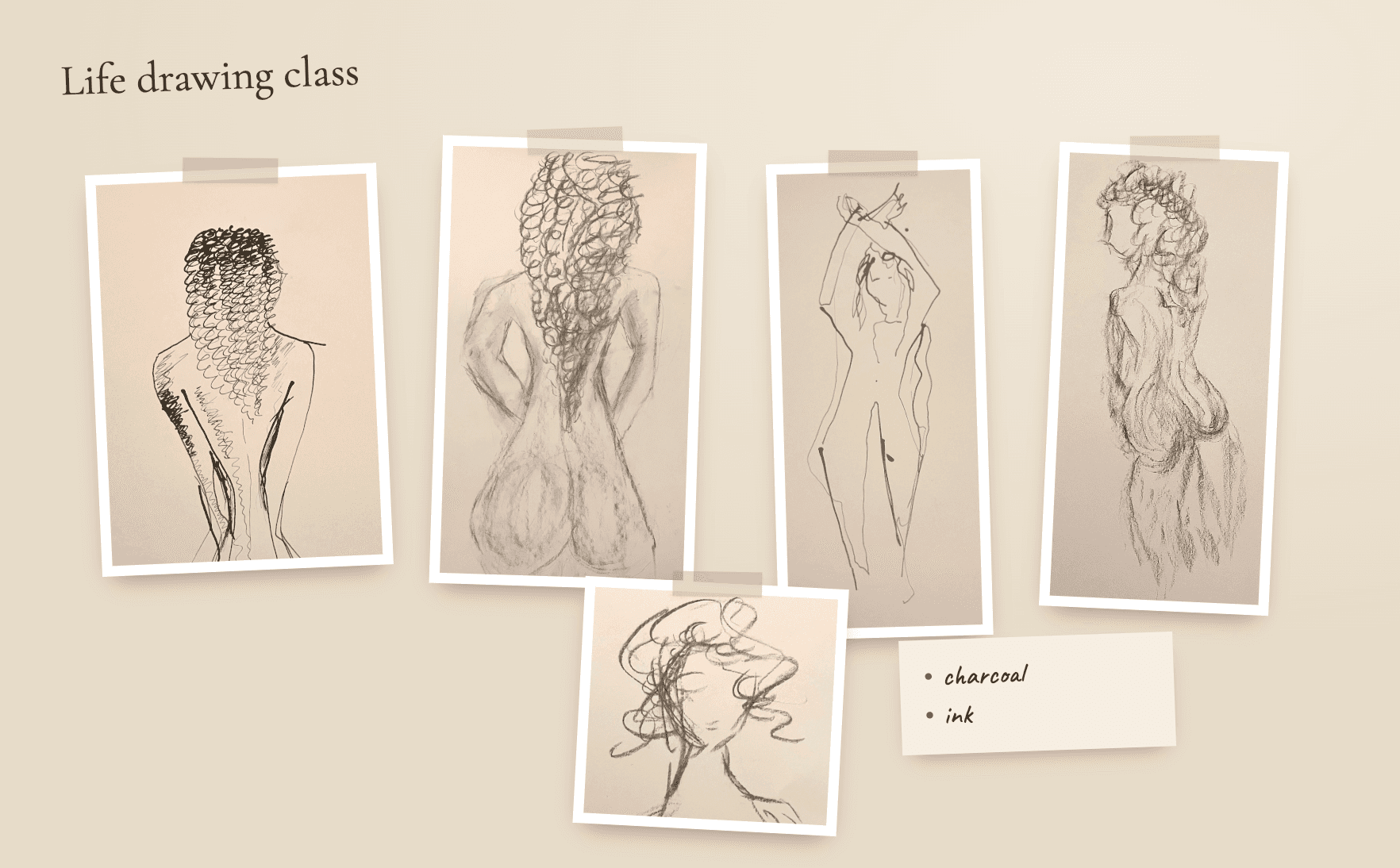
Charcoal, which was forgiving and easy to pick up
Ink, which you could create a really nice gradient with, albeit a little scratchy, using the cocktail sticks
The teacher also demonstrated how you could use wax to repel the ink and create white space on the page. A really cool technique in theory. One I didn't quite manage to master on the night.
I particularly enjoyed drawing the model's curly hair in ink and felt like it helped cover up a lot of sins.
Some of my favourite pieces were the ones I only had 10 to 30 seconds to do. Despite not being the most detailed, they conveyed the form.
At least a third of what I drew portrayed the model in various artistic styles that I didn't even know I was capable of producing. There were even a few pieces that I wasn't too embarrassed to show someone else - what a win!
What I Took Away
Part of the problem for me has always been identity. I've never really seen myself as someone who was good at art or who had any knowledge of techniques.
This has stopped me from exploring it further for quite a few years now. In a way, I'd always been the one to discount myself before I'd even had a chance to prove that theory right or wrong.
What this experience taught me is that it doesn't have to be like that.
Restrictions can be your greatest friend. When you're forced to make small moves and expect mistakes along the way, that first hurdle of just starting becomes a lot less daunting.
The restrictions forced me to fully focus on the work in front of me. And I think that's what made the time disappear.
I was just in it, enjoying the moment.
That's my biggest lesson. Don't let perfect be the enemy of good. It's not really about the result, especially if you're enjoying yourself in the process.
I'd definitely go back for another session and really look forward to seeing how my skills improve over time.
Special Thanks
To Emma, for inviting me along for such a great evening, for the beers, the laughs and some questionable drawings.
To the Grain Barge, for being the kind of place that puts on evenings like this.
To Laurel Molly, for giving us such a brilliant evening and for making a room full of strangers feel completely at ease and better artists for it.
Life Drawing
Key Summary
You meet all types at a life drawing class, from complete beginners to experts. It's a really open and inclusive environment
You don't need expensive equipment. Charcoal, basic paper, ink and cocktail sticks are as cheap as they come
Life drawing is a surprisingly good way to stay present in the moment
It gives you a better appreciation for shape and the small details you'd normally walk straight past
Don't let perfect be the enemy of good
It's as much about the process as the finished piece
How It Started
This one started with a chance conversation at the gym.
My neighbour and legendary gym buddy Emma mentioned she was heading to a life drawing class that evening and asked if I wanted to join.
I'd never been to one before and, if I'm honest, I wasn't entirely sure how I felt about the idea. Drawing someone naked felt a little strange, especially as I wouldn't class myself as particularly artistic.
But I was excited to go nonetheless.
The class was held at the Grain Barge, a local bar on a boat at the bottom of my road, hosted by local illustrator Laurel Molly. At just £9 on the door, it's one of the best value evenings out in Bristol. You can find out more and grab tickets here.
Emma and I decided to go for a few pints beforehand, have a bit of a laugh and see what happened. (I won't lie, the drinks helped!)
What I didn't know at the time was that Emma was a graphic designer and a really good artist!
The Experience
We walked into the room and picked up our paper and a selection of charcoal, ink and cocktail sticks - not quite the utensil I was expecting.
What struck me most was how confident and self-assured the model was, both in herself and her body. And how normal it felt for her to undress in front of us.
The teacher set us challenges throughout the session.
30 seconds to capture the form. A minute. 5 minutes. 10 minutes. 20 minutes.
We were also asked to experiment by drawing just using a continuous line, and also using our non-dominant hand.
It may sound counterintuitive, but the restrictions were actually freeing. You had no time to second-guess or start over, so you were forced to just draw and accept what came out on the paper.
We worked with 2 different media throughout the evening:
Charcoal, which was forgiving and easy to pick up
Ink, which you could create a really nice gradient with, albeit a little scratchy, using the cocktail sticks
The teacher also demonstrated how you could use wax to repel the ink and create white space on the page. A really cool technique in theory. One I didn't quite manage to master on the night.
I particularly enjoyed drawing the model's curly hair in ink and felt like it helped cover up a lot of sins.
Some of my favourite pieces were the ones I only had 10 to 30 seconds to do. Despite not being the most detailed, they conveyed the form.
At least a third of what I drew portrayed the model in various artistic styles that I didn't even know I was capable of producing. There were even a few pieces that I wasn't too embarrassed to show someone else - what a win!
What I Took Away
Part of the problem for me has always been identity. I've never really seen myself as someone who was good at art or who had any knowledge of techniques.
This has stopped me from exploring it further for quite a few years now. In a way, I'd always been the one to discount myself before I'd even had a chance to prove that theory right or wrong.
What this experience taught me is that it doesn't have to be like that.
Restrictions can be your greatest friend. When you're forced to make small moves and expect mistakes along the way, that first hurdle of just starting becomes a lot less daunting.
The restrictions forced me to fully focus on the work in front of me. And I think that's what made the time disappear.
I was just in it, enjoying the moment.
That's my biggest lesson. Don't let perfect be the enemy of good. It's not really about the result, especially if you're enjoying yourself in the process.
I'd definitely go back for another session and really look forward to seeing how my skills improve over time.
Special Thanks
To Emma, for inviting me along for such a great evening, for the beers, the laughs and some questionable drawings.
To the Grain Barge, for being the kind of place that puts on evenings like this.
To Laurel Molly, for giving us such a brilliant evening and for making a room full of strangers feel completely at ease and better artists for it.